William Meredith’s 1961 essay about then-new recordings of poetry, published in the Hudson Review, starts out with a point I deem apt and true, and then goes on, in my view, to misunderstand pretty much every aspect of such recordings. Naturally, though, it is an important document in the not-very-long bibliography of such writings before, let us say, 1970 or so. I am thus pleased to be making it available here: PDF. His opening point: “A poet's reading of his poems is probably as near to an ingenuous commentary as he can give us about his intentions, certainly about his designs on our ears” (470). Meredith knew very well that such use of poetic intention in 1961 was fraught — in the New Critical heyday — and I'm glad he used it knowingly, because it gives the idea a slight feel of critical difference and resistance: the oral reading of a poem written for the page does "give...intentions" especially — but not only, of course — about oral (and really: aural) design. The citation: William Meredith, “New Poetry Recordings,” Hudson Review 14, 3 (Autumn 1961), pp. 470-73.
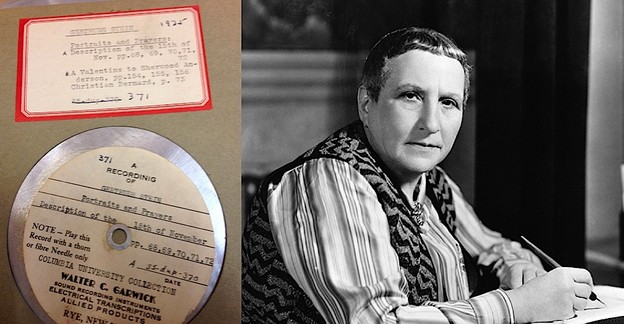
We urge readers of Jacket2 to look at — and listen to — Gertrude Stein’s PennSound author page, where new recordings have now been linked. Most who have encountered Stein’s mellifluous voice have heard it from Caedmon record TC 1050 (1956), either directly or via its digitization in PennSound.
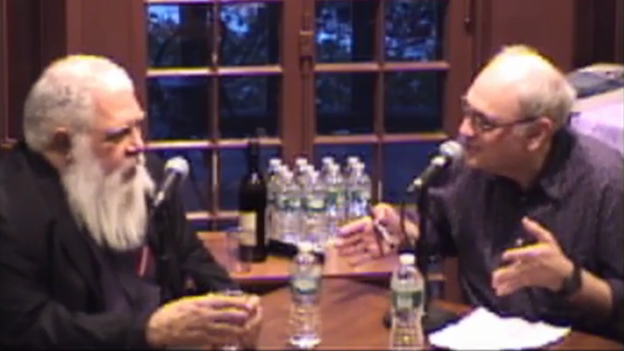
Samuel Delany (left) and Charles Bernstein (right) in a still of the recording of Close Listening.
Editorial note: The following has been adapted from a Close Listening conversation recorded as part of “The Motion of Light: A Tribute to Samuel R. Delany,” a program hosted at the Kelly Writers House in April 2014. The conversation was transcribed by Tracie Morris. Listen to the audio program here. — Julia Bloch
Some of Robert Creeley's reel-to-reel tapes given to PennSound after the poet's death
Robert Creeley recorded Ted Berrigan’s May 6, 1968 reading given in Buffalo. And Creeley gave the introduction (although, unfortunately, whoever was monitoring the tape recorder while Creeley got up to speak, only caught 27 seconds of the statement). This is the earliest recording of Berrigan currently in the PennSound archive. After his death, Creeley’s many, many recordings have been made available through PennSound. This 1968 Berrigan reading, now newly available on PennSound’s Ted Berrigan page, is one of the most remarkable poetry events Creeley documented.
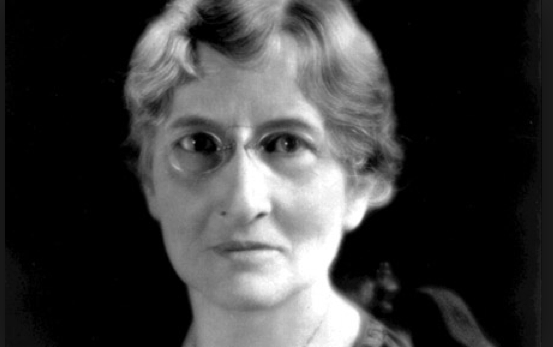
Thanks to the scholarly sleuthing, the archival negotiating, the digitizing, the uploading and filenaming, and the context-setting of Chris Mustazza, PennSound is now adding eight audio recordings of Harriet Monroe — the founding editor of Poetry and one of the crucial figures in the editorial acceptance and promotion of modernism in the U.S. — made in 1932.
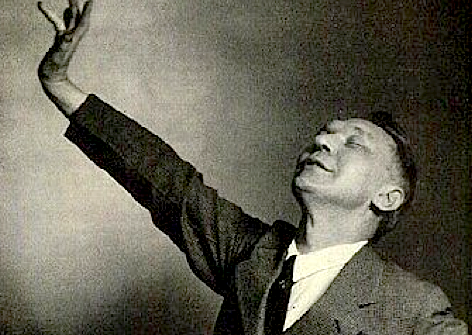
PennSound is now making available a new page of Vachel Lindsay recordings — many dozens of them. They are some of the oldeset materials in this archive. The editor of the Lindsay page is Chris Mustazza. He has described the project under whose auspices these recordings were first made onto aluminum disks. They were subsequently dubbed to reel-to-reel tapes by the Library of Congress in the 1970s. These digitizations are made from the reels, which are stored at Columbia University. We at PennSound are grateful to our colleagues at Columbia for making these unique recordings available. This is far and away the largest collection of Lindsay recordings.
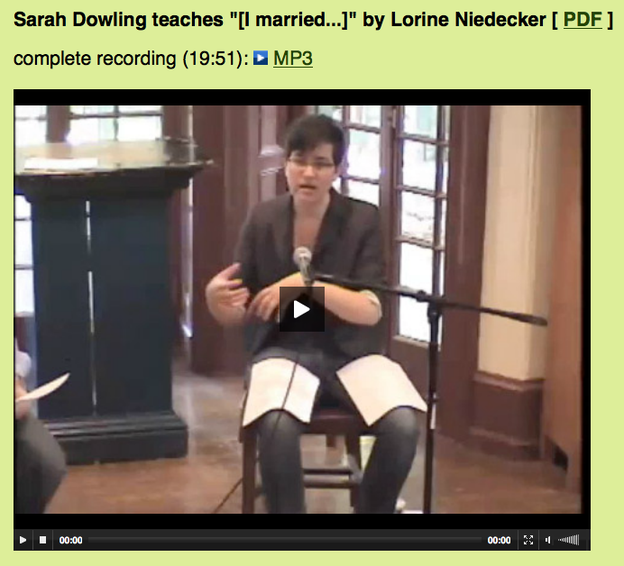
In 2009 and again in 2010, I invited six poets — each year, so twelve total — to teach one poem each to high-school juniors and seniors. Each session lasted twenty minutes. And we preserved all twelve sessions as video and audio recordings. Go here to watch or listen to them. The poems were:
1. John Ashbery, "This Room" 2. Erin Moure, "The Frame of the Book" 3. Harryette Mullen, "Trimmings" 4. John Keats, "[This living hand]" 5. Yvor Winters, "At the San Francisco Airport" 6. William Carlos Williams, "The Last Words of My English Grandmother" 7. Lorine Niedecker, "[I married...]" 8. Robert Creeley, "The Sentence" 9. Helen Chasin, "The Word Plum" 10. Frank Sherlock, "Wounds in an Imaginary Nature Show" 11. Harryette Mullen, "Zombie Hat" 12. Basho, selected haiku; John Ashbery, "37 Haiku"
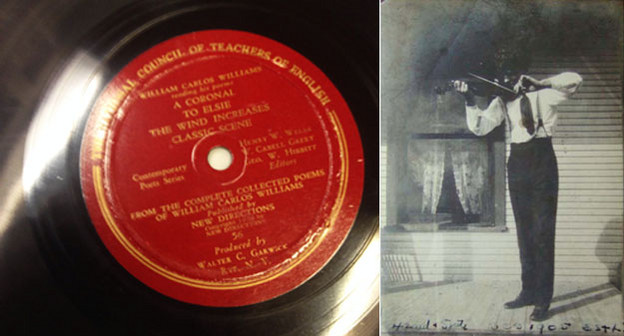
The NCTE's Contemporary Poets Series edition of William Carlos Williams reading his poetry (left), and the record's producer, Walter C. Garwick, as a young man, in 1905 (right).
The earliest known recording of William Carlos Williams reading his work was created on January 9, 1942, as part of a collaboration with the National Council of Teachers of English (NCTE) and Columbia University Press. The recording is currently available at PennSound, the largest collection of poetry recordings on the web, which is based at the University of Pennsylvania and directed by Al Filreis and Charles Bernstein.
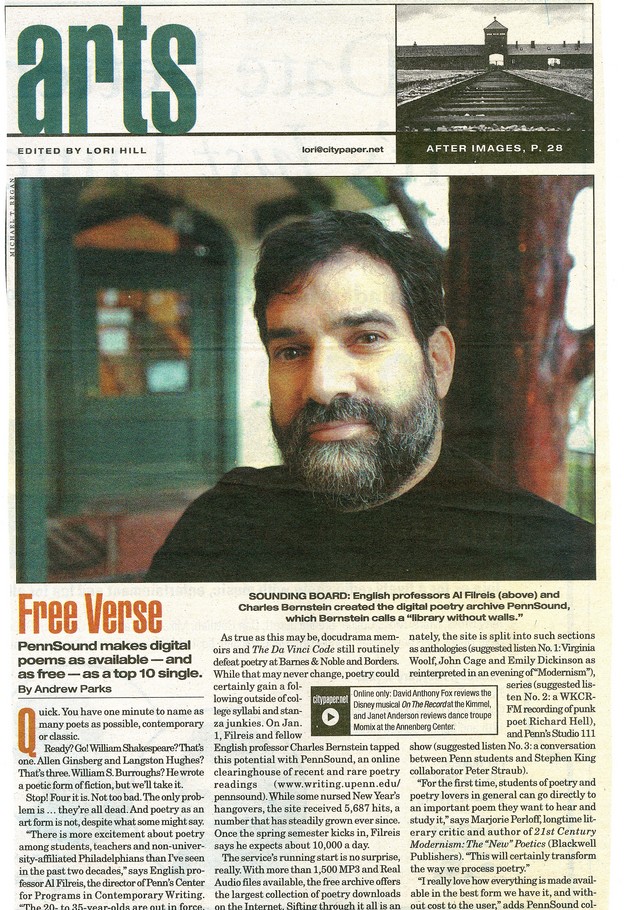

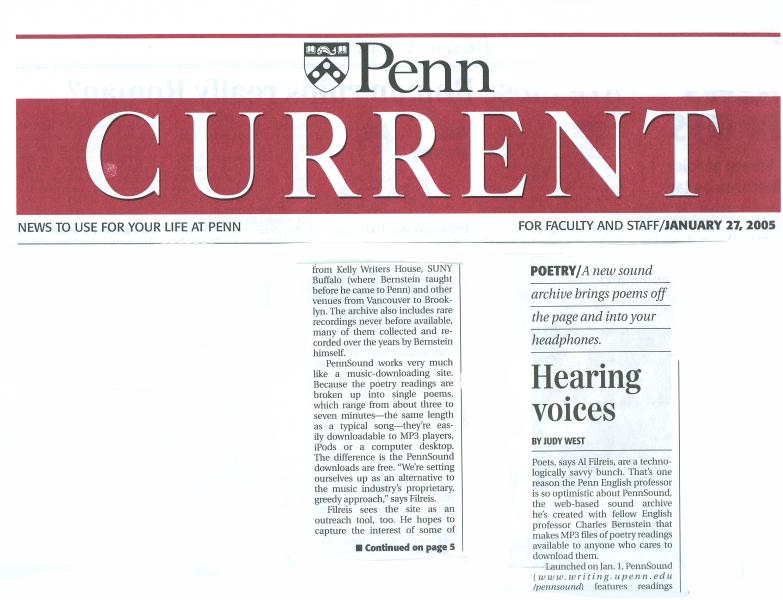
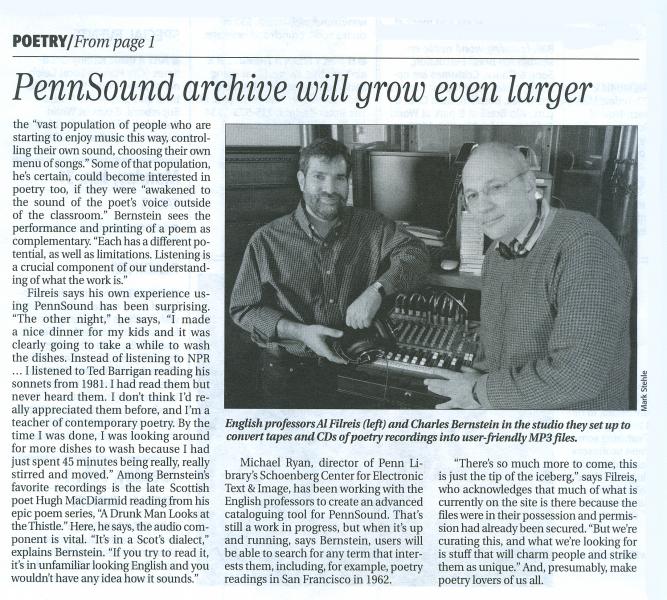 Penn Current, January 27, 2005, pp. 1, 5. Another version is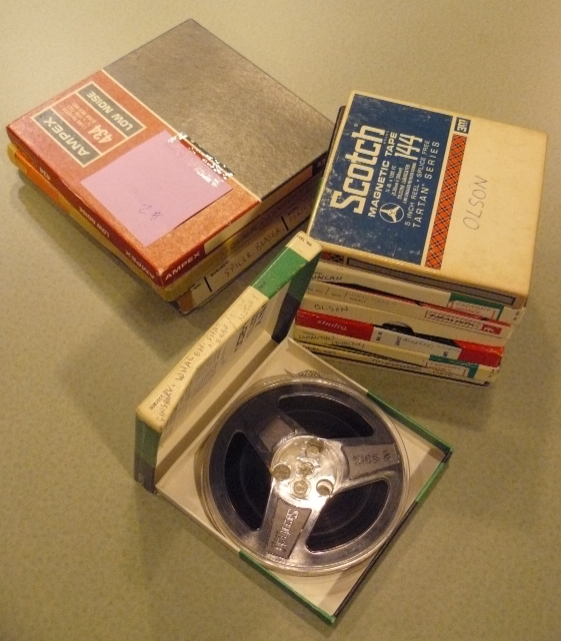

William Meredith on poetry recordings in 1961
William Meredith’s 1961 essay about then-new recordings of poetry, published in the Hudson Review, starts out with a point I deem apt and true, and then goes on, in my view, to misunderstand pretty much every aspect of such recordings. Naturally, though, it is an important document in the not-very-long bibliography of such writings before, let us say, 1970 or so. I am thus pleased to be making it available here: PDF. His opening point: “A poet's reading of his poems is probably as near to an ingenuous commentary as he can give us about his intentions, certainly about his designs on our ears” (470). Meredith knew very well that such use of poetic intention in 1961 was fraught — in the New Critical heyday — and I'm glad he used it knowingly, because it gives the idea a slight feel of critical difference and resistance: the oral reading of a poem written for the page does "give...intentions" especially — but not only, of course — about oral (and really: aural) design. The citation: William Meredith, “New Poetry Recordings,” Hudson Review 14, 3 (Autumn 1961), pp. 470-73.