Laynie Browne: Recently a show at the Morgan Library in New York City celebrated the 1913 publication of the first of the seven volumes of Swan’s Way. Here one could see some of Proust’s original handwritten manuscripts and notebooks, some of which have never left Paris. In one notebook, considering his book in progress he writes: “Should it be a novel, a philosophical essay, am I a novelist?”
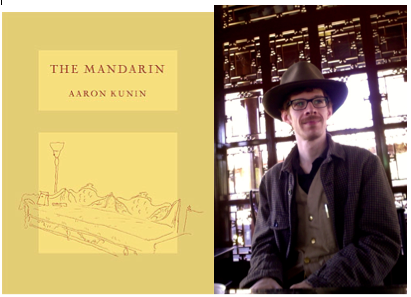
In your novel The Mandarin, the question is potently raised in various ways, who is a novelist? What is a novel? I wonder if you could comment on this. Do you think of yourself as a poet and novelist? Are the categories important or useful to you? When you set out to write The Mandarin, what were some of your initial impulses or inspirations for the project? Do you recall what turned you toward prose? Were you interested in questioning any conventional notions of the novel?
Aaron Kunin: Isn’t it strange that Proust, who is definitely a novelist, asks himself, “Am I a novelist?” If he doesn’t know, how can anyone be sure?
While I was listening to the following recordings, I kept thinking about how my friend Noah Eli Gordon used to love finding yield-to-pedestrian crosswalks when we both lived in Western Massachusetts, and how much he enjoyed simply being able to walk across the street without worrying about being crushed by a huge SUV. (We had both grown up in different parts of the sprawling Midwest where cars never stopped for pedestrians.) I don’t want to dwell too much on this personal association, but listening to each of these recordings recreated some version of that feeling of being struck by a small moment of unexpected freedom in the immediate environment.
It’s not that these recordings are full of unequivocal happiness or unchecked optimism (there’s plenty of complication, violence, distress, and danger hovering around them all), but that they temporarily create spaces for the listener to experience the interplay of phenomena, a listening-feeling that acknowledges complexity and flux but doesn’t make one feel a sensory overload (though I love recordings that do that too).
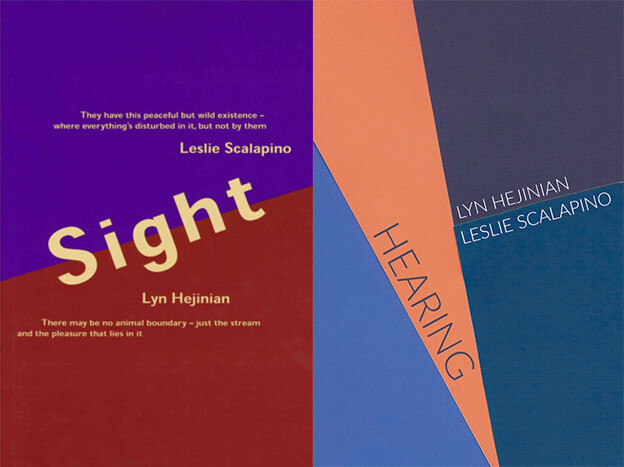
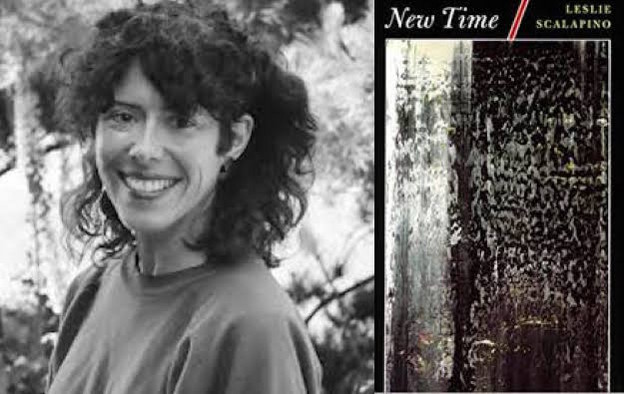
Scalapino is always just ahead, inventing the essay anew, as a necessary means for the exploration of consciousness, perception, and meaning in and for language, with full engagement with, and acknowledgement of, the political valences of every poetic act as it falls into, or fails, the social. In the expanded field of L=A=N=G=U=A=G=E, Scalapino's essays are central: a model not just of possibilities but of "landing sites" to use the term of Madeline Gins and Arakawa.
Tracy Grinnell has done a superb job assembling this collection, which Scalapino was working on at the time of her death about a year ago. As always, Scalapino pushes beyond any easy sense of essay. What unfolds here is the startling unexpectedness of thought, articulated in visual and verbal forms that confound genre categories. In this book, Scalapino creates fields for thinking-as-perception, in which the poem emerges from the essay as counterpoint and newly forming foundation. The complex of disparate parts creates working models for a social formalism. Scalapino introduces the terms "seamless antilandscape" to acknowledge that an aversion to traditionl representation does not produce disjunction but rather a syncretic perceptual experience.
A conversation with Aaron Kunin
The poet's novel
Laynie Browne: Recently a show at the Morgan Library in New York City celebrated the 1913 publication of the first of the seven volumes of Swan’s Way. Here one could see some of Proust’s original handwritten manuscripts and notebooks, some of which have never left Paris. In one notebook, considering his book in progress he writes: “Should it be a novel, a philosophical essay, am I a novelist?”
In your novel The Mandarin, the question is potently raised in various ways, who is a novelist? What is a novel? I wonder if you could comment on this. Do you think of yourself as a poet and novelist? Are the categories important or useful to you? When you set out to write The Mandarin, what were some of your initial impulses or inspirations for the project? Do you recall what turned you toward prose? Were you interested in questioning any conventional notions of the novel?
Aaron Kunin: Isn’t it strange that Proust, who is definitely a novelist, asks himself, “Am I a novelist?” If he doesn’t know, how can anyone be sure?