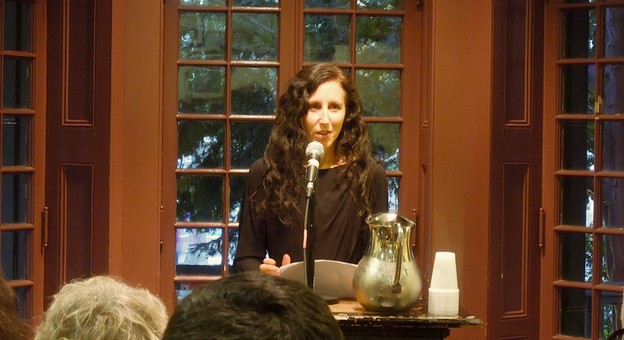
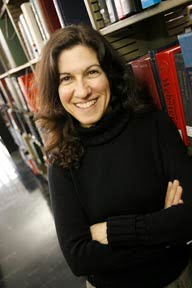
Jessica Lowenthal

Daytime never ends (PoemTalk #63)

Laynie Browne, "Daily Sonnets"

LISTEN TO THE SHOW

PoemTalkers Jessica Lowenthal, Lee Ann Brown, and Sueyeun Juliette Lee gathered with Al Filreis to talk about five poems from Laynie Browne’s Daily Sonnets, which was published by Counterpath Press of Denver in 2007. We chose two of Browne’s “fractional sonnets,” two of the sonnets in which the talk of her children is picked up partly or wholly as lines of the poem, and one of her “personal amulet” sonnets.

Inalienable writes (PoemTalk #47)

Rosmarie Waldrop, 'Shorter American Memory of the Declaration of Independence'

Rosmarie Waldrop. Photo by Steve Evans.

LISTEN TO THE SHOW

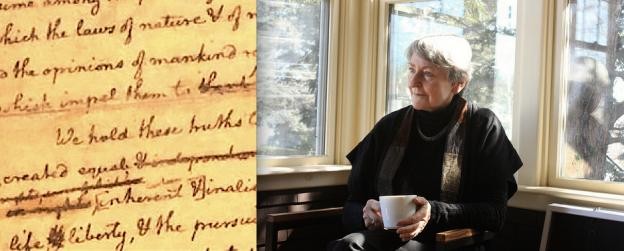
Rosmarie Waldrop’s book Shorter American Memory consists of prose poems collaged from documents collected in Henry Beston’s American Memory, a book of the late 1930s evincing an Americanist zeal for early documents. Beston's historicism seemed a liberal effort to restore and include in the American story, as it was being retold during the Depression, a wide range of Native American as well as both obscure and classic “founding” or “first encounter” Euro-American writings. By appying various constraints to these documents, Waldrop rewrites Beston by “taking liberties” — an intentional pun on her part — with the gist of the anthology and its very length. In doing so, (to quote her publishers at Paradigm Press) she “unearths compelling clues into America's perception of its own past, developing a vision of America vital for its intelligence, wit & compassion.”

We at PoemTalk decided to take a close look at one of these prose poems, “Shorter American Memory of the Declaration of Independence.” A performance of this poem, preceded by a short introduction, was recorded at Buffalo in 1992. The main work of that reading was to present many chapters from Key into the Language of America, a project related to that of Shorter American Memory in several ways we mention in our discussion. As a warm-up to Key, she read three of her writings-through Beston: ours on the Declaration, a second on Salem, and a third on “the American Character According to [George] Santayana.”  Here is a link to Waldrop's PennSound page, where these and many other recordings are linked.<--break- />

Inalienable writes (PoemTalk #47)

Rosmarie Waldrop, "Shorter American Memory of the Declaration of Independence"

Rosmarie Waldrop. Photo by Steve Evans.

LISTEN TO THE SHOW

Rosmarie Waldrop's book Shorter American Memory consists of prose poems collaged from documents collected in Henry Beston's American Memory, a book of the late 1930s evincing an Americanist zeal for early documents. Beston's historicism seemed a liberal effort to restore and include in the American story, as it was being retold during the Depression, a wide range of Native American as well as both obscure and classic “founding” or “first encounter” Euro-American writings. By appying various constraints to these documents, Waldrop rewrites Beston by “taking liberties” — an intentional pun on her part — with the gist of the anthology and its very length. In doing so, she (to quote her publishers at Paradigm Press) “unearths compelling clues into America's perception of its own past, developing a vision of America vital for its intelligence, wit & compassion.”

We at PoemTalk decided to take a close look at one of these prose poems, “Shorter American Memory of the Declaration of Independence.” A performance of this poem, preceded by a short introduction, was recorded at Buffalo in 1992. The main work of that reading was to present many chapters from Key into the Language of America, a project related to that of Shorter American Memory in several ways we mention in our discussion. As a warm-up to Key, she read three of her writings-through Beston: ours on the Declaration, a second on Salem, and a third on “the American Character According to [George] Santayana.”  Here is a link to Waldrop's PennSound page, where these and many other recordings are linked.

Teaching Emily Dickinson on line

Does success in circuit lie?

Finding the words (PoemTalk #37)

Jena Osman, 'Dropping Leaflets'

LISTEN TO THE SHOW
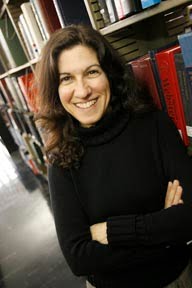
For an event held at the Writers House on November 7, 2001, Jena Osman composed a new poem — one might say thus that it’s an occasional poem. The occasion was given the overall title “Finding the Words” (as in: how can writers find words to bespeak a response to 9/11?) and Osman’s poem was “Dropping Leaflets.”

Here is verbatim what Osman said as she introduced the poem at the Writers House: “The title of this program is ‘Finding the Words.’ Every day I look in the newspapers. I keep sensing the presence of what's not being told... ‘Help me come up with a strategy to get through this white noise.’ I don't have that strategy, except to call attention to components of that white noise so we can hear it for what it is. In the spirit of Marianne Moore, who often incorporated what she was reading into her poems, I’m going to read a piece made of words I found when I read transcripts of press conferences given by Bush, Ridge, Rumsfeld, and Cheney in the last few days. I read the transcripts, printed them out, I tore them up, and then I stood on a chair, and then I bombed my office floor with them as if they were leaflets and the leaflets told me what to do. So this piece is called ‘Dropping Leaflets.’”

The text of the poem is given here. It was published subsequently in a book, An Essay in Asterisks (Roof Books, 2004). The recording made on November 7, 2001, is available on Osman’s PennSound author page and linked here.

Al Filreis convened Mark Nowak, Emily Abendroth and Jessica Lowenthal to talk about this poem and more generally some aspects of documentary poetics. They considered, among other things, what happens to such a historically specific writing when some of the context fades as a memory — and whether the aesthetic qualities of the poem become a primary impression. And yet the poem’s rhetoric — if that's the right term for a poem constructed of found phrases — speaks to the very question of how we can make ourselves heard in all the centralizing, nationalistic white noise at such a moment.<--break- />

Finding the Words (PoemTalk #37)

Jena Osman, "Dropping Leaflets"

LISTEN TO THE SHOW

For an event held at the Writers House on November 7, 2001, Jena Osman composed a new poem--one might say thus that it's an occasional poem. The occasion was given the overall title "Finding the Words" (as in: how can writers find words to bespeak a response to 9/11?) and Osman's poem was "Dropping Leaflets."

Here is verbatim what Osman said as she introduced the poem at the Writers House: "The title of this program is 'Finding the Words.' Every day I look in the newspapers. I keep sensing the presence of what's not being told... 'Help me come up with a strategy to get through this white noise.' I don't have that strategy, except to call attention to components of that white noise so we can hear it for what it is. In the spirit of Marianne Moore, who often incorporated what she was reading into her poems, I'm going to read a piece made of words I found when I read transcripts of press conferences given by Bush, Ridge, Rumsfeld, and Cheney in the last few days. I read the transcripts, printed them out, I tore them up, and then I stood on a chair, and then I bombed my office floor with them as if they were leaflets and the leaflets told me what to do. So this piece is called 'Dropping Leaflets.'"

The text of the poem is given here. It was published subsequently in a book, An Essay in Asterisks (Roof Books, 2004). The recording made on November 7, 2001, is available on Osman's PennSound author page and linked here.

Al Filreis convened Mark Nowak, Emily Abendroth and Jessica Lowenthal to talk about this poem and more generally some aspects of documentary poetics. They considered, among other things, what happens to such a historically specific writing when some of the context fades as a memory - and whether the aesthetic qualities of the poem become a primary impression. And yet the poem's rhetoric--if that's the right term for a poem constructed of found phrases--speaks to the very question of how we can make ourselves heard in all the centralizing, nationalistic white noise at such a moment.

the 32nd PoemTalk

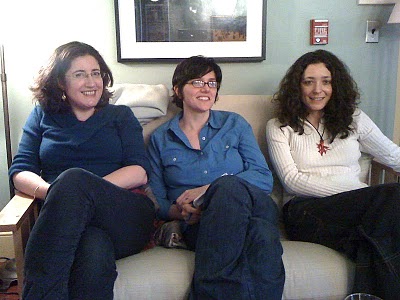
From left to right: Marcella Durand, Jessica Lowenthal, Jennifer Scappettone. They're in my office at the Writers House, having just finished discussing Susan Howe's reading of Emily Dickinson's "My Life had stood - a Loaded Gun." It's the 32nd episode of the PoemTalk podcast. Please have a listen.
Art and power (PoemTalk #32)

Emily Dickinson's 'My Life had stood…' and Susan Howe's 'My Emily Dickinson'

LISTEN TO THE SHOW


Art and power (PoemTalk #32)

Emily Dickinson's "My Life had stood..." and Susan Howe's "My Emily Dickinson"

LISTEN TO THE SHOW

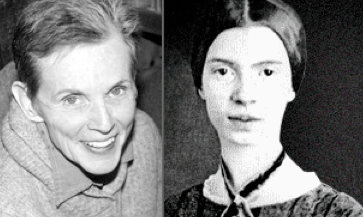
Jennifer Scappettone, Marcella Durand and Jessica Lowenthal joined Al Filreis for a discussion of Susan Howe's understanding of a crucial and extraordinarily complex poem by Emily Dickinson--the one that begins "My Life had stood - a Loaded Gun."

My Life had stood--a Loaded Gun--
In Corners--till a Day
The Owner passed--identified--
And carried Me away--

And now We roam in Sovereign Woods--
And now We hunt the Doe--
And every time I speak for Him--
The Mountains straight reply--

And do I smile, such cordial light
Upon the Valley glow--
It is as a Vesuvian face
Had let its pleasure through--

And when at Night--Our good Day done--
I guard My Master's Head--
'Tis better than the Eider-Duck's
Deep Pillow--to have shared--

To foe of His--I'm deadly foe--
None stir the second time--
On whom I lay a Yellow Eye--
Or an emphatic Thumb--

Though I than He--may longer live
He longer must--than I--
For I have but the power to kill,
Without--the power to die--


Attempts to read and understand the poem form a central analytical narrative, or, one is tempted to say, a viscerum in and through Susan Howe's book My Emily Dickinson. Our group not only took a cue from Howe's sense of the poem's centrality; we used the recording of Howe's reading of the poem--and several passages from her book--as our basis and starting point. The recording comes from Charles Bernstein's interview with Howe for his LineBreak series; the entire series is available through PennSound.

Jen Scappettone's comments help us contemplate Howe's working out Dickinson's sense of the way war enters the details of domestic existence. Al presents the extended conceit (the woman is to the man as a gun is to its hunter-owner) and then the four proceed--immediately--to complicate it, aptly. The gendering, Marcella and Jessica remind us, is not at all straightforward. Among the many questions pondered here: How do we know for certain that the gun is gendered female?

Dickinson offered several variant words. One of these is "art," which might have replaced "power." "For 'art' you need an artist," Marcella notes, "the creative power. Can the gun be the artist? Do artists extend power? What was the role of the artist or writer in America?" We listen to Howe (reading from her book) say, "When I love a thing, I want it and I try to get it." Sounds to us, at least partly, like a predatory version of the subject-object dynamic. Jen adds: "Love brings the owner and the gun together, but also the predator and the prey." Jessica speaks surely for all of us at PoemTalk when she says, in her final word, that she's glad to return to this crucial poem over and over.

The sort of person you imagine (PoemTalk #18)

Lydia Davis, 'A Position at the University'

LISTEN TO THE SHOW

PoemTalk finally goes squarely at the question of authenticity, and — wouldn’t you know it? — we do so through a piece that is not in any conventional sense a poem. Lydia Davis’ “A Position at the University” (published with other similar short prose pieces in Almost No Memory) suggests to Jessica Lowenthal that on this day our show was “PoemProseTalk.” Fair enough. Is it a very short story – in the mode of what we call “fiction”? Not really. Is it a poetic parable in prose? (It struck Al at one point as very much like a pondering paragraph from Wittgenstein’s Philosophical Investigations.) Thank goodness we brought sociologist David Grazian along. David observes that this piece is like an ethnographic field note. A field note that observes the following: In daily life, authenticity functions the way imagination does. What advantage is derived by writing about authenticity in this linguistically circular manner, in the grammar of mild-seeming discontent? Well, for one thing, it stipulates a poetics; the language of the piece makes us acutely aware as we read or listen that anxiety is the close kin of identity, because identity-naming is always partial whereas the named/identified subject is always hoping for wholeness. That discrepancy – that difference – creates a weird aura, and perhaps this is why Adrian Khactu senses that this piece belongs in the category of mundane SF, the newish sci fi mode in which there are no monsters, scientific abnormalities, cruel transformations. Perhaps the cruelest transformation is what happens every day when a person who thinks of herself in one way is assumed to have a “position” otherwise.

Syndicate content