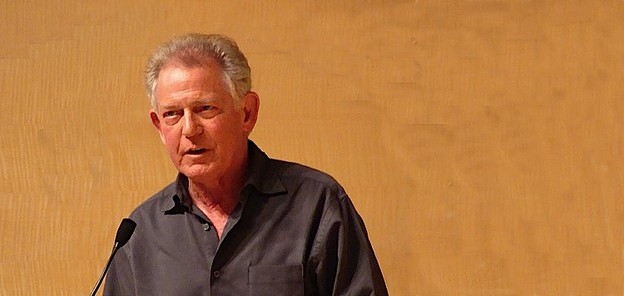
On March 17, 2014, Julia Bloch hosted a conversation about the relevance of the Beats in contemporary poetry, with Frank Sherlock, Michelle Taransky, Maria Raha, Chris McCreary, and Thomas Devaney. The session was webcast live, and was tweeted with the #PhillyBEATS hashtag. The video recording is available here, and the audio recording of the session is available here.
Marci Nelligan, David Kaufmann, and Thomas Devaney joined Al Filreis to discuss what David thinks might well be one of Bill Berkson’s own signature songs; during our discussion, David opines that Berkson’s poem “Signature Song” is the best of the poet’s “fact poems.” Marci and Tom certainly did not disagree with that judgment. Its diction and tone are mostly that of familiar factistic subgenres: the liner note, the encylopedia entry, etc.
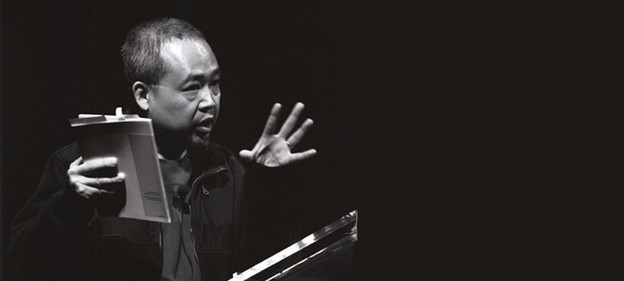
Linh Dinh playfully and bitterly engages food, war, and race in a poem called “Eating Fried Chicken.” The poem appeared in his book American Tatts, published by Chax in 2005. For PoemTalk’s 51st episode, Thomas Devaney, Susan Schultz (visiting from Hawai'i), and Leonard Schwartz (visiting from Olympia, Washington) joined Al Filreis to talk about this work of apparently straightforward address yet tonal complexity.
Read Edgar Allan Poe's “Dream-Land” even just once and discover that it’s not at all clear if this land of dreams is the place from which the speaker has come, or is, rather, his longed-for destination — or if indeed it is the very mode and means and route endured along the way. Subject and object, both; content and form likewise; it is the process that demonstrates the importance of desired ends. “Thule,” a northerly, arctic/Scandinavian sort of zone,[1] is apparently an origin "from" which the speaker has traveled, but it is also apparently “it” — a “wild clime” neither geographical nor temporal, “Out of SPACE— out of TIME.” And “it” is also a space through which one passes.
Thomas Devaney, John Timpane, and Jerome McGann greatly admire what Poe achieved here. For them it is a matter of a sort of wild control. The poem seems to go where it will (and that’s its point) but the speed — as matter of tongue, teeth and lips saying its words — is managed at the level of the line. The poem is intensely languaged, as is the selfhood of the “I” whose journey is always already the poem. And so this work, as an act of writing, far transcends its Gothic conventions.
Our poem is Kit Robinson’s “Return on Word,” collected in Robinson’s 2002 book, The Crave, which was published by Lyn Hejinian and Travis Ortiz at Atelos Press.
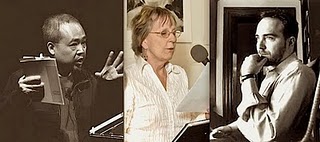
Rae Armantrout was in from San Diego and joined Linh Dinh, Tom Devaney and host Al Filreis for our conversation this time. At turns the group interprets the poem as a satirization of the referentially super-confident language of marking; as a critique of Language poetry (an aesthetic gathering with which Robinson has long been identified); as an expression of skepticism about the monetization and militarization of American rhetoric. Linh wishes Robinson had pushed the poem’s anti-marketing tendencies a bit further. Rae, who is a fan of Mad Men and herself knows a thing or two about poetically torquing flattened idiomatic speech, admires the way “all we need is a few good words” plays upon military linguistic merchandizing. Tom is positively devastated by the notion that thought might take “a contract out on” words.
Finally, the group agreed that the poem is about words’ value, seen through the dystopia of their devaluation at the hands of economic sectors in which referential certainty is guaranteed to get carried away – in which a good (profitable) year is anticipated by, maybe even determined by, the right people in the room thinking up just the right dead language for the moment.
If we look in the direction
these words will have to do adding to the enormous burden of words
The entire concept is entirely too conceptual all we need is a few good words
Anybody can relate to to declare an identity no one can take away
But which ones a handful of interest several people in a room
For several hours couldn’t come up with the point is to decide
Then move as one up and down in an altered state
This is easier said than done we are getting close, very close we are getting better
We are going to have a great year there is going to be hell to pay it’s gonna be a fuckin bloodbath
Then the return to words thought has taken a contract out on in order to move them around
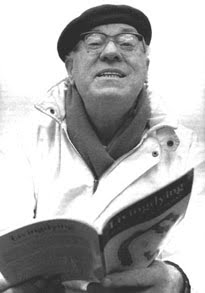
Back in 2001 the people of the Kelly Writers House wanted to bring Cid Corman--long by then a resident of Kyoto, Japan--to Philadelphia to be with us, give a reading, meet some of his readers. But one thing or another--cost, Cid's health--made this impossible. So we set up a combination of a phone link to Cid in Kyoto and a live audiocast feed; in this way, the fifty of us in the Arts Cafe of the Writers House and another 75 or so listening on their computers around the world were able to enjoy a reading by Cid, ask him questions, and make at least that limited sort of contact with the founder of Origin, crusty prolific exile, author of tens of thousands of poems. The November 2001 event was moderated by PoemTalk's producer and host, Al Filreis, along with Frank Sherlock, Fran Ryan and Tom Devaney.
Fast forward. Cid Corman died in 2004. Bob Arnold, Philip Rowland, Jack Kimball, Joe Massey and others have worked hard to keep Cid's poems within the view of readers--especially Bob Arnold whose Longhouse Press published The Next One Thousand Years, the Selected Poems of Cid Corman. And then, as part of the PoemTalk series, we staged a mini-reunion of the November 2001 Cormanite moderators, Fran, Tom, Frank and Al, to talk about one of our favorite poems, "Enuresis."
It means bed-wetting. The poem puts forward this audacious claim to understanding: I know the terror you've experienced in the midst of war because as a child I held my urine close to me for fear of my parents' terrifying enmity. The claim is made with such poetic consciousness (at the level of word choice and meter - and in the spoken performance) that one hardly doubts the power of the homefront psychic terror being remembered.
Above is Lyn Hejinian's typescript of an untitled poem we've taken to calling "constant change figures."
It is one poem in a series Hejinian has been writing, a project she currently calls The Book of a Thousand Eyes. If it is finished (perhaps, she tells us, in the summer of 2009?), it might consist of 1,000 poems; more likely of 310 or a few more of them (the number she had completed at the time this episode was recorded). Some poems in the series appeared in The Little Book of a Thousand Eyes, published by Smoke-Proof Press--although, please note, our poem, "constant change figures," does not appear in that gathering. When Hejinian visited the Writers House a few years ago, she read 19 of these gorgeous little eyes, including ours. And it's the audio recording made during that reading that we use in our show.
To what extent does our notion of nature's picture--a picture of the many things we name "out there--surprass the things we already know? We seem to deem memory nature's picture. So to what extent is experience the result of our living in time, a state producing senses that are familiar and yet move us forward toward new and different effects?
So, truly, constant change figures the time we sense. "Figures" there--a transitive verb at that point--enacts things: change makes things, shapes them, renders them, gets things just so.
As you can tell from the recording, we were astonished that these words could accomplish all that thinking about words? Can you imagine writing a poem of nine triads, 27 lines in all, each line this carefully rendered--a poem that in all uses far fewer unique words than the total number of words in the poem, far fewer than conventional utterances would need to employ. Fewer, let's say, than required by the language of philosophy telling of the same phenomena.
During our lively Hejinian PoemTalk, Tom Mandel in particular works out for us the way the shifting yet repeating triads are enacted. Bob Perelman focuses on Steinian memory (forgetting something himself along the way), Thomas Devaney on the power of turned-every-which-way phrasal variations, Al Filreis on the Steinian mode (again) and the poem as a possible critique of the ideology of experience.
We agree that from the time of her great Stein talks* and of Writing Is an Aid to Memory Lyn Hejinian has conceived of writing itself, an act that is at once a matter of forgetting and remembering, as a definition (or an "aid" to the redefinition) of the past.
Is this poem itself--its very manner and form--an instance of what Hejinian famously observed in My Life - "the disquieting runs of life slipping by"? Yes. The four PoemTalkers seemed to agree on that at least. As Bob Perelman notes, the poem itself seems to slip by one. Succinct as it is, one can't seem to hold it all in one's mind at once.
* Click here for a PennSound recording of Hejinian talking about and reading her own writings through Gertrude Stein.


 Finally, the group agreed that the poem is about words’ value, seen through the dystopia of their devaluation at the hands of economic sectors in which referential certainty is guaranteed to get carried away – in which a good (profitable) year is anticipated by, maybe even determined by, the right people in the room thinking up just the right dead language for the moment.
 Back in 2001 the people of the Kelly Writers House wanted to bring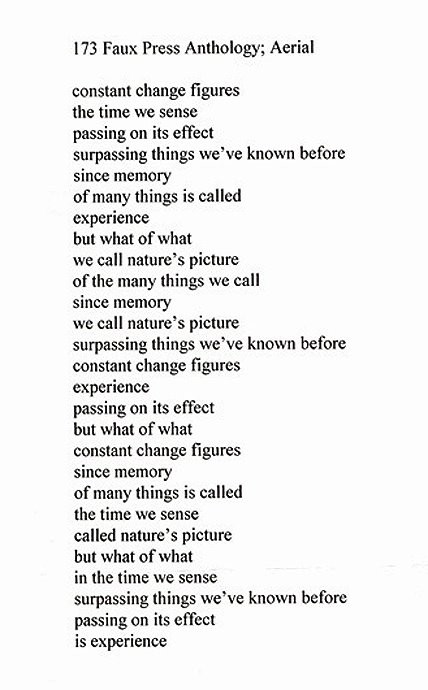
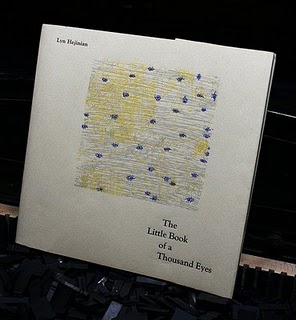 It is one poem in a series Hejinian has been writing, a project she currently calls The Book of a Thousand Eyes. If it is finished (perhaps, she tells us, in the summer of 2009?), it might consist of 1,000 poems; more likely of 310 or a few more of them (the number she had completed at the time this episode was recorded). Some poems in the series appeared in The Little Book of a Thousand Eyes, published by
 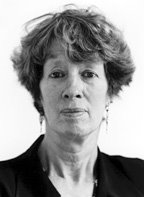 We agree that from the time of her great Stein talks* and of Writing Is an Aid to Memory Lyn Hejinian has conceived of writing itself, an act that is at once a matter of forgetting and remembering, as a definition (or an "aid" to the redefinition) of the past.
The Beats today
A conversation with Philadelphia writers, hosted by Julia Bloch
On March 17, 2014, Julia Bloch hosted a conversation about the relevance of the Beats in contemporary poetry, with Frank Sherlock, Michelle Taransky, Maria Raha, Chris McCreary, and Thomas Devaney. The session was webcast live, and was tweeted with the #PhillyBEATS hashtag. The video recording is available here, and the audio recording of the session is available here.