Bob Perelman, 'The Unruly Child'
LISTEN TO THE SHOW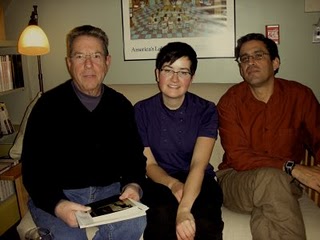
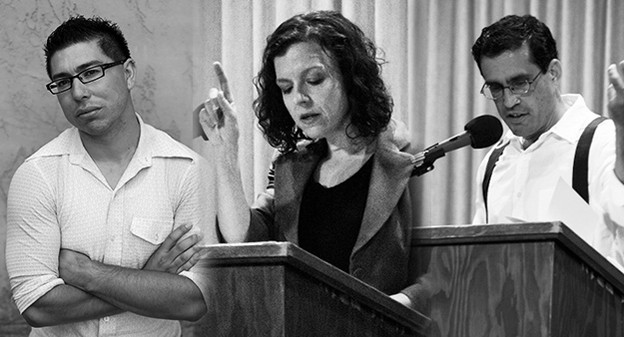
At right, left to right, PoemTalkers Tom Mandel, Sarah Dowling, Rodrigo Toscano.
Bob Perelman began to write “The Unruly Child” using as a pattern Cesar Vallejo’s “The Right Meaning”. Vallejo: “Mother, you know there is a place somewhere called Paris. It’s a huge place and a long way off and it really is huge.” The Peruvian’s own mother had been dead many years at the time her son wrote the prose-poem, and it is a sad call back from late 1930s Paris (with all its politics, both fascist and antifascist — a tense scene in which Vallejo participated) to a lost Peruvian motherness — pre-self-exilic, pre-political.
The gesture creates a distance and a desperate emotion at once. “I want both modes of address to resonate,” Perelman wrote to us at PoemTalk before our discussion. “Vallejo’s heartfelt/estranged address to his mother is further estranged by my detourned quoting, but it’s heartfelt, too. Kind of a chiastic structure: heartfelt/estranged: estranged/heartfelt.”
Tom Mandel, a second-time PoemTalker and an old colleague of Perelman, wanted (at least at first) to stave off theoretically sophisticated readings and to talk of the poem’s speaker as Perelman himself: Bob the witty talented impatient poet, Bob the literally unruly son. In its late-70s/early-80s political context, the poem risked being deemed mere bourgeoisified radicalism; but on second much-later thought, it seems to succeed in tracing the deformed social development of the political son of the American mother who learns the language by refusing to learn its “right” meaning.
 Thus the term “unruly” is crucial to all this poet's pajama play: a certain energetic conception of language has a politics. Sarah Dowling helpfully discusses the word “desirable” in connection with Marathon Oil. “If you’re the unruly child,” Sarah notes, “you have to ask questions as to why it [Marathan Oil] is not desirable.” What values inhere in that skepticism? What do they do to the nostalgically summoned mother? “The unruly child,” adds Rodrigo Toscano, “is a place for language to shake out in periods of instability, a transition from one historical moment to the next. And it seems to want to reset the terms under which he is willing to talk politically. He’s trying to renegotiate how he’s going to be a hostage to representation.” Tom Mandel heartily agrees with that. In the poem, we have this directive: “Learn the language. / That beautiful tongue-in-cheek hostage situation.” (It’s a 1979/80-ish poem and the situation is of course the American Embassy hostage-taking in Teheran.)
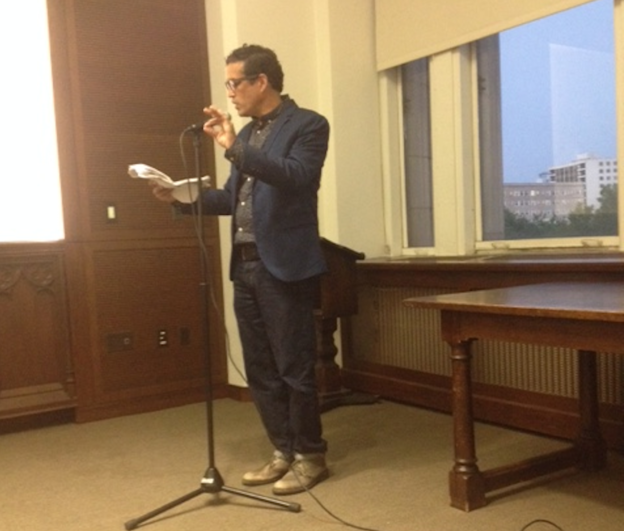
“The Unruly Child” was published in To the Reader (1984), an early Perelman book, and then reprinted in Ten to One, his book of selected poems. He recorded this poem for PennSound’s Studio 111 series in 2004, offering a brief comment on each poem recited. Before reading our poem, he mentions that To the Reader was the first book in which he regularly “used the present political landscape for subject matter.” 
July 6, 2009


 Thus the term "unruly" is crucial to all this poet's pajama play: a certain energetic conception of language has a politics.
'You' and the poetics of slow violence
Reading Jose Antonio Villarán's 'Open Pit: A Story About Morococha and Extractivism in the Américas'
Jose Antonio Villarán’s Open Pit asks how to write a catastrophe whose immanence is dissipated across space and time. Tracking the poet’s research on transnational extractivism in the Peruvian mining town of Morococha, Open Pit essays a poetics of Rob Nixon’s “slow violence,” catastrophes (being products of human choices) which play out across scales that defy a pinpointed “there.” Writing in Davis, CA, to a young son in Philadelphia about research in Morococha, Peru, Villarán sets a network of places as actants, grafted onto variable patterns of placement on the page, carving tracks of space for the words of people interviewed in Morococha, descriptive language on the products of research, and autobiographical first- and second-person verse.
Open Pit was published by Counterpath Press in 2022. The Spanish Tajo Abierto will be published in June 2023 by Álbum del Universo Bakterial in Lima, Peru.
“I want to be there with you and i’m not”