Robert Creeley

Digitizing Creeley's reel-to-reel tapes

Robert Creeley and son Will (photo by Bruce Jackson)

Will Creeley sent us at PennSound this great note after hearing a PoemTalk episode about one of his father's poems:

I saw word of this latest episode via PennSound's excellent & useful Twitter feed, and figured it was a good opportunity to say thank you again to Al, Charles and everyone at PennSound & Kelly Writers House for taking in our big cardboard boxes and digitizing the reel-to-reel recordings inside with such care and precision.

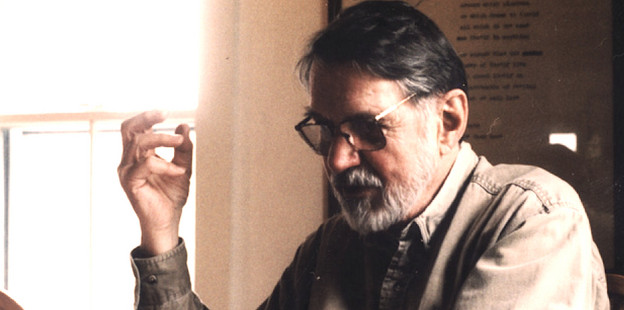
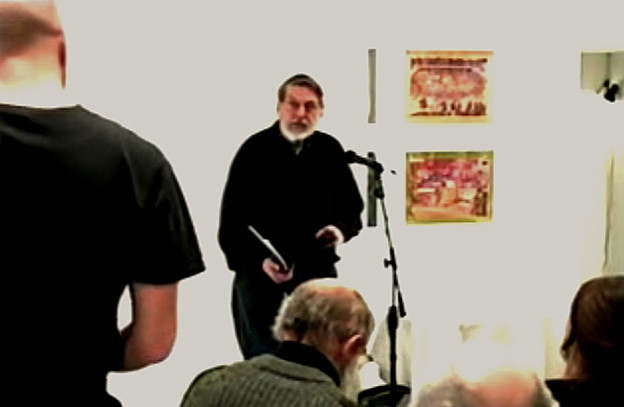
Creeley near the end

A beautiful late reading given by Robert Creeley, CUE Art Foundation, January 18, 2005. We at PennSound provide the video and also the audio-only recording of this event.

"When I think of where I come from....of what a life is, or was...," begins the first poem in the reading. Creeley died in March of '05, just a few months later.

PoemTalk update

Who's counting? Well, but...Who's counting? Well, but... Here are the most often listened-to PoemTalk episodes in the last two weeks: 1) W. C. Williams, 2) Robert Creeley, 3) Wallace Stevens, 4) Jaap Blonk, 5) Cid Corman, 6) Allen Ginsberg singing Blake, 7) Amiri Baraka, 8) Ezra Pound, 9) Barbara Guest. I'm not counting the new Vachel Lindsay show; it received the largest number of hits but was just released, so its traffic resulted in folks responding to a widespread announcement. We'll see next month if people are still listening to the Lindsay. I certainly hope so.

Because I am always talking (PoemTalk #16)

Robert Creeley, "I Know a Man"

LISTEN TO THE SHOW

Robert Creeley's "I Know a Man" is in many ways a signature poem. Few poems we choose to discuss on PoemTalk are such. Many are downright unrepresentative. This one might indeed be unrepresentative but if a person knows just one Creeley poem this is probably it.

It's been much written about. In The San Francisco Renaissance Michael Davidson explores the "Beat ethos" with a detailed reading of "I Know a Man." Similarly, PoemTalkers Randall Couch, Jessica Lowenthal and Bob Perelman find beat here--but also its counterargument, and/or a rejoinder to its dark depth and to the beat propensity for driving nowhere (or somewhere) fast. Robert Kern in boundary 2--a 1978 essay--finds postmodern poetics in the Creeleyite anthem: in a nutshell, composition as recognition. Cid Corman (himself the topic of an upcoming PoemTalk) finds and commends the "basic English" of the poem, comparing it with a "more refined" and less effective poem on a similar topic by Louis MacNeice. Walter Sutton back in '73 drew a line of influence from Charles Olson's poetics to Creeley's "laconic" and "spasmodic" lineation and rhetoric.

The PoemTalkers talk about this remarkable instance of eloquent stammering. The stammer is perhaps the apt way--since form is never more than an extension of content, and vice versa, after all!--of heading into the surrounding mid-1950s darkness, only to be brought up short by the actual needs of the actual American road. It is not a resolution and not a capitulation, but an assertive and possibly ironic (funny, anyway) means of bringing up short. Or, in short: more stammering.

I Know a Man

As I sd to my
friend, because I am
always talking,—John, I

sd, which was not his
name, the darkness sur-
rounds us, what

can we do against
it, or else, shall we &
why not, buy a goddamn big car,

drive, he sd, for
christ’s sake, look
out where yr going.

Our friends at the Poetry Foundation have listed and linked all episodes of PoemTalk here. And, as always, one can subscribe to PoemTalk through the iTunes music store; simply type "PoemTalk" in the Music Store search box.

There are, at last count, eight different recordings of Creeley reading this poem - all to be found, along with much more, on PennSound's Creeley author page. Not long after his father's death, Will Creeley brought to us boxes of reel-to-reel tapes, which we have gone through carefully, digitizing, segmenting, identifying poem by poem.

Because I am always talking (PoemTalk #16)

Robert Creeley, 'I Know a Man'

LISTEN TO THE SHOW

Robert Creeley’s “I Know a Man” is in many ways a signature poem. Few poems we choose to discuss on PoemTalk are such. Many are downright unrepresentative. This one might indeed be unrepresentative but if a person knows just one Creeley poem this is probably it.

It’s been much written about. In The San Francisco Renaissance Michael Davidson explores the “Beat ethos” with a detailed reading of “I Know a Man.” Similarly, PoemTalkers Randall Couch, Jessica Lowenthal and Bob Perelman find beat here — but also its counterargument, and/or a rejoinder to its dark depth and to the beat propensity for driving nowhere (or somewhere) fast. Robert Kern in boundary 2 — a 1978 essay — finds postmodern poetics in the Creeleyite anthem: in a nutshell, composition as recognition. Cid Corman (himself the topic of an upcoming PoemTalk) finds and commends the “basic English” of the poem, comparing it with a “more refined” and less effective poem on a similar topic by Louis MacNeice. Walter Sutton back in ‘73 drew a line of influence from Charles Olson’s poetics to Creeley’s “laconic” and “spasmodic” lineation and rhetoric.

The PoemTalkers talk about this remarkable instance of eloquent stammering. The stammer is perhaps the apt way — since form is never more than an extension of content, and vice versa, after all! — of heading into the surrounding mid-1950s darkness, only to be brought up short by the actual needs of the actual American road. It is not a resolution and not a capitulation, but an assertive and possibly ironic (funny, anyway) means of bringing up short. Or, in short: more stammering.

The Williams who torques sentences

The William Carlos Williams that motivated a young Robert Creeley was The Wedge of 1944. For Ron Silliman and--he suspects--others among those who "became known as Language Poet[s]"--the key Williams was to be found in Spring & All (1923). They found it in the 1970 Frontier Press edition.

Silliman believes that one of the important distinctions between the Language Poets and earlier avant-garde generations was their "different reading" of Williams - their Spring & All-centered reading of him.

Syndicate content